

TL;DR: In this guide, you’ll discover 7 high-impact strategies to turn targeted email marketing into a powerful revenue driver. Plus, learn how using a CRM like Leadhub CRM can unlock automation, personalization, and real ROI.
Email is still one of the most cost-effective marketing channels available. According to Statista, over 376 billion emails are sent daily, with that number projected to reach 408 billion by 2027. Email remains the backbone of digital communication, and a powerhouse for marketing ROI.
In fact, email marketing generates between $36 and $44 for every $1 spent (Litmus, 2024; Campaign Monitor, 2025), with top performers seeing up to $68 ROI per dollar (Omnisend, 2024). Even more compelling, 87% of marketers say email is critical to their business success (HubSpot, 2025), and nearly 50% of consumers made a purchase directly from an email in the past year (Campaign Monitor, 2025).
If you’re spending hours a week sending emails without results, chances are you’re missing key strategies or not leveraging automation tools that can 10x your output.
Below are 7 essential ways to get the most from targeted email marketing, with bonus insights on how integrating a CRM and email automation can scale your results.
1. Build a Quality Email List That Converts
This is where it all begins. It’s also the part that many businesses struggle to achieve.
Popups have become absolutely brutal while navigating almost any site. They are everywhere.
But when one pops up saying something like “Join our email list to get new recipes delivered to your inbox every single day!” what do you do?
If you’re anything like me, you immediately start looking at how to click away from the popup. Some pop-ups have become extra annoying. They don’t show you the “X” to click off of it, so you feel like you’re trapped. What to do then? Instantly leave the site!
This is not the way to build a quality email list. It is, however, a way to chase people away before they even explore your content!
Unless you have an absolutely ridiculous offer that someone will receive just for giving you their email (a free oil change, for example), skip the popups.
So how do you build your list? Here are some high-performing techniques:
Post-Purchase Incentives:
After a sale, offer customers a substantial discount code for their next purchase in exchange for providing their email. This mutually beneficial arrangement encourages customers to share their email and allows you to provide them with exclusive offers and updates.
On-Site Email Collection:
Take advantage of your website’s traffic by creating a quick and user-friendly web form to capture email signups. Highlight the benefits of joining your email lists, such as exclusive offers, product releases, and valuable content. Make the signup process clear, concise, and hassle-free to maximize conversions.
Leverage Social Media:
Tap into your social media following to drive email list growth. Direct your followers to a dedicated web form to sign up for exclusive offers and discounts. Emphasize that subscribing to your email list is the gateway to receiving unique benefits and staying informed about your brand.
In-Store Opt-Ins:
If you have a brick-and-mortar store, seize the opportunity to capture email addresses at the checkout counter. Train your staff to ask customers if they want exclusive offers by joining your email list. You’ll be surprised at the number of customers willing to provide their email, especially when informed about the benefits they’ll receive.
Streamlined Signup Process:
Make it simple for customers to sign up for your email list. Minimize the required information to the essentials (e.g., name and email address). Implement a double opt-in process to ensure high-quality leads and filter out potential junk emails.
Value-Added Approach:
Always provide value (or highly perceived value) in return when asking for email signups. Gone are the days when a generic “weekly newsletter” would suffice. Instead, entice customers with exclusive offers, valuable content, early access to new products, or personalized recommendations tailored to their needs.
Building a robust email list is essential for B2B businesses seeking to engage customers and drive conversions. Once you start building a quality list, your targeted email marketing will automatically start to improve.
2. Personalize Every Email — With More Than Just a Name
“Hi Jessie!” beats “Dear Customer,” but that’s just the start. Real personalization uses CRM data to:
- Recommend products based on past purchases
- Send reminders or offers based on customer behavior
- Trigger emails based on lead stage, inactivity, or sign-up source
Automated emails, though making up just 2% of volume, drove 37% of all email-generated sales in 2024 (Omnisend, 2024). This shows how effective personalization and automation can be.
Once they get to your message, your first line better be powerful.
More on that later.
3. Emojis in Your Subject Line Help You Stand Out
Look at your inbox right now. What do you see? Words, words, and more words right?
Hundreds of words garbled together seem like a daunting task to get through. So what happens? You end up going through your inbox and deleting dozens of emails without even opening them.
We all do it.
Most of us use emojis in our personal conversations. It’s a fun way to express ourselves. When you incorporate a few emojis in your email’s subject line, it gets the reader’s attention. It makes them feel like it’s personal, and they are more likely to open it. They also cut through the overwhelming stream of words. Then they should see, “Hey Becky!” and you’re on your way.
Here are a few examples:
- “🔥 Don’t Miss Out on Exclusive Discounts! 💼”
- “⏰ Time is Running Out! Grab Your Deal Today! 💥”
- “🌟 Unleash Your Business Potential with Our New Solution! 💡”
- “🚀 Skyrocket Your Sales with Our Cutting-Edge Technology! 💯”
- “💰 Boost Your ROI with Our Limited-Time Offer! 💼”
- “🎯 Get Ahead of the Competition – Unlock Your Success! 🏆”
- “🔑 Unlock the Secrets to Sales Success! Discover Our New Guide! 📘”
- “✨ Elevate Your Business with Our Proven Strategies! 💼”
- “🎉 Celebrate Success with a Special Offer – Exclusive for You! 🎁”
- “🔧 Streamline Your Processes and Increase Efficiency! 💼”
Remember, when using emojis in email subject lines, make sure they are relevant to the content of your email and align with your brand’s messaging and audience.
4. Send at the Right Time (and Keep Testing)
Timing can make or break your open rates. There’s no hard or fast rule on this. It varies based on your business type.
For example, if you’re a bar owner and want to announce an unexpected two-for-one night that evening, you probably don’t want to send it in the morning.
The best time to send would be about an hour before office people are leaving work.
Send your emails when it makes the most logical sense for your business. Remember, most people have push notifications on their phones when they receive an email. Make your message timely to get it opened.
In addition, always be testing. Separate your email list into 4 different groups and send the identical email at 4 different times.
- Try mid-mornings for B2B
- Evenings or weekends for B2C
- Test different days/times by segment
CRM-powered automation lets you:
- Schedule based on time zones
- Trigger sends based on customer behavior
- Continuously analyze send-time performance
Then dive into the analytics and sales results.
A major study of 20 million emails showed that 11 a.m. Eastern Time had the highest open rate. That may or may not be true for you, but I would suggest using that time for one of your sends and seeing for yourself.
A major key to targeted email marketing is always be testing your send times.
5. Use Custom, Mobile-Responsive Email Templates
Yes, services like Constant Contact and MailChimp offer many responsive templates for free.
However, today’s consumers are very sophisticated. They know right away they are getting an email from one of these services.
It can make you look a little small time.
To stand out and look like a big player in your industry, have a custom email template designed. However, make sure that the template is fully responsive on all devices.
A whopping 66% of all emails are now viewed on mobile devices or tablets. If you have a template that doesn’t format properly on mobile, you’re going to lose the vast majority of those readers almost instantly.
Just like with your website, responsiveness is no longer an after-thought. It’s an absolute must.
Leadhub CRM includes drag-and-drop templates that are optimized for mobile and conversion.
6. Always Include a Direct Call to Action
Ending an email with “These patio sets are on sale now thru June 1st” is not going to be effective. All that does is tell the reader they have plenty of time to think it over.
Then minutes later, they forget all about your email.
Never assume the reader knows what to do next.
Bad: “Sale ends soon.”
Better: “Click here to claim your 25% discount before midnight.”
Add CTAs in:
- Subject lines (“Open Now: Your Bonus Awaits”)
- Email body (bold buttons or links)
- PS sections (reminders increase click-through rates)
With CRM workflows, you can automate follow-ups if no click occurs, keeping the lead warm without manual effort.
7. Write Good Copy. Pour Over Every Word. Test, Test, Test.
You’ve got the reader’s attention. They’ve opened your email.
Now, what message do you have that will get them to the next level?
The opening line of your email is where it’s at. Make it personal. Make it impactful. Use power words to get the reader to keep reading past the opening line.
When you do your testing, play with the wording of your opening line and again, segregate your list into 4 parts. After a few weeks of seeing what’s converting, it becomes much easier to write a great opening line.
Once you get past the opening line, get to your offer or message as quickly as possible. Make is short and concise. Avoid using too many words.
Write short sentences and paragraphs so there is a lot of white space. When people see 8 sentence paragraphs of words, it intimidates them out of reading your message.
After writing your copy, go back through and figure out which words you can remove.
For example, in the prior sentence, we had originally written, “After you’re done writing your ad copy, spend some time going back through it to figure out which of the words you can remove from it.”
See the difference?
Short and concise copy sells.
Bonus: CRM + Automation — The Secret to Scalable Email ROI
If you’re still sending manual email blasts to a static list, you’re missing the real power of automation. CRM-backed email marketing doesn’t just save time. It completely transforms how you nurture leads, engage clients, and drive revenue. Here’s how:
Dynamic Segmentation With a CRM like Leadhub, you can segment contacts based on:
- Lifecycle stage (new lead, prospect, client)
- Behavior (pages visited, emails clicked, calls made)
- Product or service interest
- Demographics or location
Automated Workflows Put follow-ups and engagement on autopilot:
- Welcome series for new subscribers
- Abandoned cart recovery emails
- Post-purchase thank you messages
- Win-back campaigns for inactive clients
These sequences run automatically based on rules you define, keeping leads warm even while you sleep.
Personalized Triggers Forget one-size-fits-all blasts. Send messages based on:
- Customer action (or inaction)
- Time delay after an event (e.g., 3 days after purchase)
- Specific behaviors (e.g., visiting a pricing page)
Leadhub CRM lets you tailor each interaction so every message feels timely and relevant.
Data-Driven Optimization Leadhub includes real-time performance tracking for your emails:
- Open and click rates
- Conversion tracking
- A/B testing
- Funnel drop-off points
This data feeds into your workflows so you can continuously improve performance.
All-in-One Control with Leadhub CRM Leadhub is built for local service providers who need results, not complexity. From one dashboard, you can:
- Capture leads from web, phone, and social
- Track every interaction in a unified inbox
- Automate email, SMS, and review follow-ups
- Manage proposals, invoices, and payments
- Book appointments and reduce no-shows
- Monitor sales pipelines and lead quality
77% of email ROI comes from segmented, targeted, and triggered campaigns (DMA, 2024). Email is 40x more effective at acquiring customers than Facebook or Twitter (McKinsey & Company, 2024).
Whether you’re starting out or scaling up, Leadhub offers flexible plans tailored to your business size and goals. Even one extra closed deal per month can pay for your CRM and then some.
Don’t let another lead slip through the cracks. Explore LeadHub CRM and see the difference automation makes.
25 Must-Know Email Marketing Stats (2026 Edition)
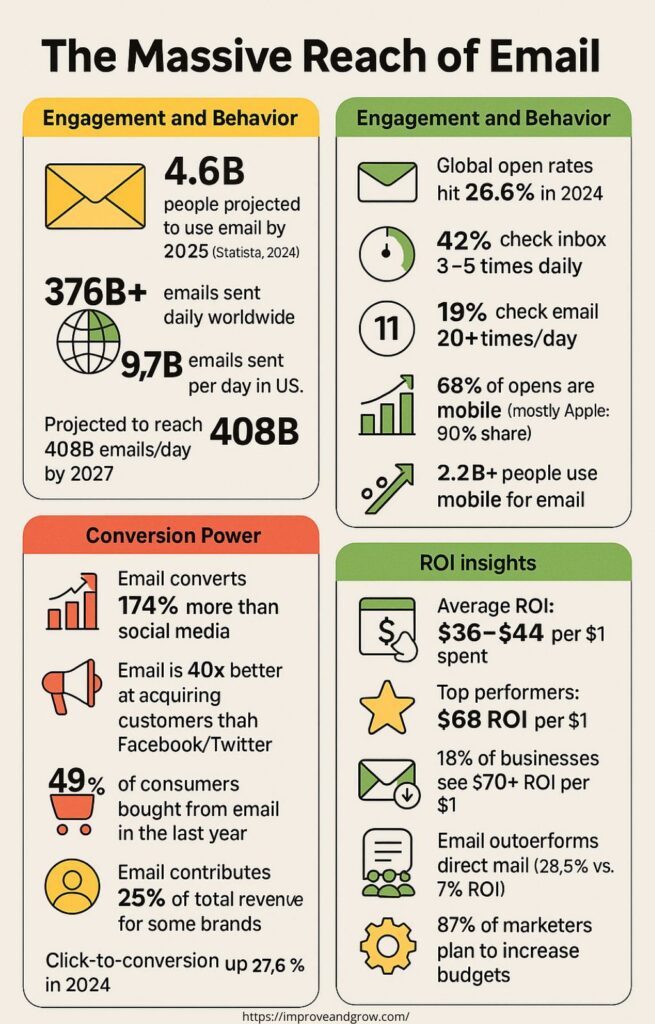
- 4.6 billion people are projected to use email by 2025 (Statista, 2024)
- Over 376 billion emails are sent daily worldwide (Statista, 2024)
- Email volume is expected to hit 408 billion per day by 2027 (Statista, 2024)
- The U.S. alone sends 9.7 billion emails per day (Statista, 2024)
- Global open rates reached 26.6% in 2024 (Campaign Monitor, 2025)
- 87% of marketers say email is critical to business success (HubSpot, 2025)
- 49% of consumers made a purchase from email in the past year (Campaign Monitor, 2025)
- Email ROI ranges from $36 to $44 per $1 spent (Litmus, 2024)
- Top performers earn $68 ROI per $1 (Omnisend, 2024)
- Automated emails generated 37% of email revenue in 2024 (Omnisend, 2024)
- But automated emails were only 2% of total volume (Omnisend, 2024)
- 77% of email ROI comes from segmented campaigns (DMA, 2024)
- Email converts 174% more than social media (Campaign Monitor, 2024)
- Mobile email open rates hit 68% (Campaign Monitor, 2024)
- Over 2.2 billion people use mobile for email (Radicati Group, 2018)
- 42% of users check inbox 3 to 5 times daily (HubSpot, 2025)
- 19% check email more than 20 times per day (HubSpot, 2025)
- Apple accounts for 90% of mobile email opens (Campaign Monitor, 2024)
- Best open rates occur around 11 AM ET (Campaign Monitor, 2024)
- Click-to-conversion rates rose 27.6% in 2024 (Omnisend, 2024)
- Email contributes 25% of total revenue for some brands (eMarketer, 2025)
- Email is 40x better for acquisition than Facebook or Twitter (McKinsey, 2024)
- 18% of businesses see $70+ ROI per $1 spent (Campaign Monitor, 2025)
- 87% of marketers plan to increase email budgets (Email on Acid, 2024)
- Email outperforms direct mail (28.5% vs. 7% ROI) (Chief Marketer, 2024)
Conclusion
Email marketing works, but not if you’re stuck sending generic messages manually. By combining smart strategy with the automation power of a CRM like Leadhub, you can turn email into one of your highest-performing growth channels.
Ready to take your email marketing to the next level? Let’s talk.