Executive Summary
A camp marketing strategy is not about “doing marketing.” It is about gaining clarity before you invest.
John didn’t want “marketing.” He wanted clarity.
As a new director operating within a denominational structure, he couldn’t simply experiment with digital campaigns. Any meaningful investment required approval from his district superintendent and board leadership. That meant he needed more than an audit or a service proposal — he needed a camp marketing strategy.
He needed straightforward answers to important questions:
- Is there enough demand in our market to justify investment?
- What channels should we prioritize?
- What level of budget makes sense?
- What kind of return is reasonable to expect?
- What systems need to be in place before scaling lead flow?
Rather than jumping straight into tactics, Cross Oak invested in a structured Growth Action Plan — a strategic engagement designed to evaluate opportunity, model potential returns, and build a path forward the board could confidently support.
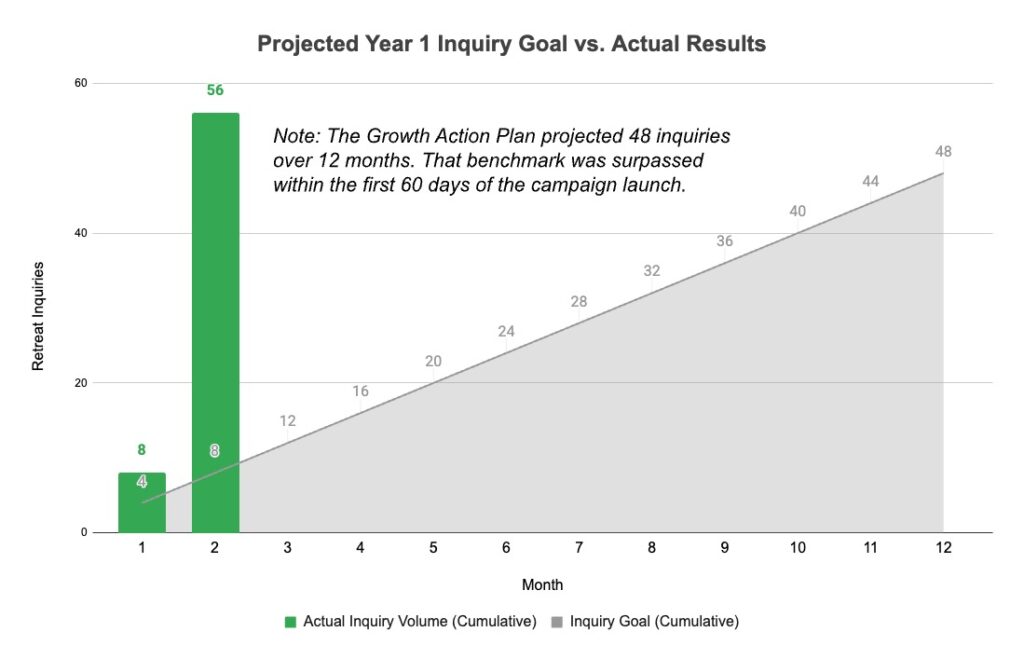
Within two months of launching the strategy developed in that plan, Cross Oak generated more than 50 new retreat inquiries, booked new events, and began approaching capacity in previously underutilized timeframes.
The results came quickly. But they weren’t random.
They were the outcome of doing the strategic work first.
The Challenge
During our initial discovery conversation, John articulated something many camps and retreat centers quietly experience.
When groups toured the property, they booked. Nearly every time.
The facilities exceeded expectations. The pricing was highly competitive. The atmosphere resonated. In John’s words, the most common response he heard was: “We had no idea this existed.”
Conversion wasn’t the problem. Awareness was.
Cross Oak was filling many peak-season weekends, but there were still gaps — particularly midweek and in the offseason. Operationally, the team had the capacity to host multiple groups simultaneously. They had dining space, meeting rooms, and lodging flexibility to support growth.
Logistics weren’t holding them back. Visibility was.
At the same time, John was navigating the realities of leadership. Increased bookings meant increased expectations. The board was discussing future expansion. Revenue was rising. And as a new director, he needed to ensure every investment decision was responsible, defensible, and aligned with long-term camp growth strategy.
He didn’t just need more leads.
He needed a strategy he could confidently explain and defend.
The Solution
A Strategy Before Services
Instead of presenting a generic audit or immediately recommending campaigns, we began with a Growth Action Plan.
This wasn’t a surface-level review. It was a focused strategic engagement built around one central question:
Is marketing investment justified — and if so, what’s the smartest path forward?
The plan included in-depth market demand research, competitive visibility analysis, search behavior evaluation, and a full review of Cross Oak’s current digital systems. We examined how their website functioned, how inquiries were captured, how their custom CRM was configured, and where tracking gaps existed.
We also modeled revenue potential based on group value, booking rates, and realistic lead-to-booking scenarios. Rather than promising vague “growth,” the plan tied projections to real inputs and operational realities.
The result was a documented roadmap that clarified:
- Where real demand existed in their region
- How visible (or invisible) Cross Oak was in non-branded searches
- Which channels offered the greatest leverage
- What level of investment aligned with their growth goals
- What kind of return could reasonably be expected
For the first time, John had more than a proposal.
He had a plan he could bring to his board with confidence.
The conversation shifted from, “Should we try marketing?” to, “Does this make sense for where we’re trying to go?”
That shift mattered.
Focused Execution Aligned to Research
Because the strategy was clear, implementation stayed focused.
The plan identified two primary leverage points: strengthening the website so it functioned as a true lead-generation hub, and capturing high-intent search demand from ministry leaders already looking for retreat venues.
The website was rebuilt with clearer messaging, intentional inquiry pathways, and proper tracking integration. Just as importantly, the inquiry experience itself was redesigned. The previous site collected only basic contact information and an open comment field, which meant every inquiry required manual clarification before a tour could even be scheduled.
The new forms were structured to capture meaningful pre-tour details — group type, estimated attendance, preferred dates, lodging needs, and other key planning information — allowing Cross Oak to qualify opportunities earlier and respond with greater precision. Every submission flowed directly into their CRM, giving the team both visibility and context. This wasn’t simply about generating more inquiries; it was about generating better, more structured inquiries that supported faster follow-up and stronger booking outcomes.
At the same time, targeted search campaigns were launched to reach people actively seeking Christian retreat facilities within driving distance. This was not broad awareness advertising. It was inbound marketing — meeting decision-makers at the moment they were already searching.
Each tactic followed directly from the research in the Growth Action Plan.
The Results
The new system launched in early December.
By February, Cross Oak had already generated over 50 new retreat inquiries, and they have 3X the number of confirmed bookings for this year vs. the same time last year. Because those inquiries now included richer planning details from the outset, the team was able to prioritize high-fit groups, streamline communication, and move qualified opportunities toward booking more efficiently than before. The bookings they have already secured more than covered their initial investment, and with continued momentum, they are well positioned to meet their initial growth goals and realize the 13X ROI projected in their strategy.
Most importantly, the early performance closely reflected the projections outlined in the Growth Action Plan — reinforcing that the opportunity identified in research was real and attainable.
The volume of interest was strong enough that leadership began discussing enhancements to their CRM workflows to better manage increased demand and prepare for continued growth.
Here directly from John:
“I just want to say how genuinely impressed I am with what you, Jen, and the entire Improve & Grow team have built for us. The impact has been significant. Even though I’ve been here less than a year, the difference is unmistakable. My phone and inbox are consistently full of new inquiries. Guests regularly comment on how intuitive and professional the website feels, and the momentum from the marketing is real. We’re projecting an increase of more than 37% from when we started. That kind of growth doesn’t happen by accident. It’s a direct result of the strategy and execution behind the Growth Action Plan.”
The speed of the results wasn’t the product of aggressive spending or experimentation.
It came from clarity and alignment.
What Changed
The most significant transformation wasn’t simply an increase in inquiries.
It was alignment across leadership and operations.
Cross Oak now operates with a documented growth roadmap, leadership buy-in around marketing investment, measurable performance tracking, and a scalable system designed to support expansion.
Instead of reacting to inquiries and hoping referrals fill the gaps, they now have a proactive, data-backed strategy guiding their decisions.
Board conversations have shifted from uncertainty to intentional planning.
That changes everything.
Final Word
Many organizations hesitate to invest in a structured strategy project. It can feel slower than launching ads or less exciting than redesigning a website.
An audit identifies problems. A proposal lists services.
A Growth Action Plan defines a quantified, data-backed path to revenue.
For Cross Oak Camp, investing in strategy first provided clarity, confidence, and leadership alignment. It turned marketing from a risky experiment into a responsible growth initiative.
And when execution followed that strategy, results followed quickly.
When you know exactly where to aim, you don’t waste effort — and you don’t waste budget.
If you’re evaluating your own camp marketing strategy and wondering whether the opportunity in your market justifies investment, the right first step isn’t a proposal — it’s a plan.
Would a data-backed Growth Action Plan bring clarity to your next season of growth?
Schedule a discovery call to explore what that could look like for your organization.