

The Challenge
Groups that toured the property booked. Almost every time. The facilities beat expectations, the pricing was well under the market, and the grounds did most of the selling. The line John heard again and again was: “We had no idea this existed.”
Conversion was never the problem. Almost nobody knew the camp was there.
So he set out to fix it himself. He had a friend pull a list of every church, school, and nonprofit within a hundred miles, somewhere between 1,500 and 2,500 organizations, and he started dialing. He got through about 600 of them and booked three or four groups. Those are respectable numbers for cold outreach, and John is unusual among camp directors in that he genuinely enjoys the work. It was still costing him hours a day he did not have.
The turning point came on a Saturday. His only cook called off, so John was on the grill, and when the group’s recreation block started he went and ran that too. He came back to a voicemail from a prospect he had been chasing for weeks, calling to talk about booking a camp. He knew exactly what that missed call meant. Responding fast is most of the game, and he could not respond fast while doing three other jobs.
There was one more constraint, and it is the one that makes this hard for most denominational camps. Any real investment had to be approved by his superintendent and defended to leadership. John could not simply try something and find out.
The Plan
What John came looking for was not a marketing campaign. He wanted to know whether the opportunity was actually there, because that was the question he would have to answer for Andy and the board.
So that is where we started, with a Growth Action Plan rather than a proposal. We measured the real search demand in their service area and found more than 12,000 conversion-intent searches a month within driving distance. We looked at who was capturing it and found that Cross Oak’s share of that market, statewide, rounded to zero. Their Google Business Profile was busy, but nearly all of that traffic came from people already searching the camp by name. Then we modeled what a realistic path from inquiry to booking would be worth, and built three versions of the plan at three investment levels so John could weigh the tradeoffs rather than take our word for it.
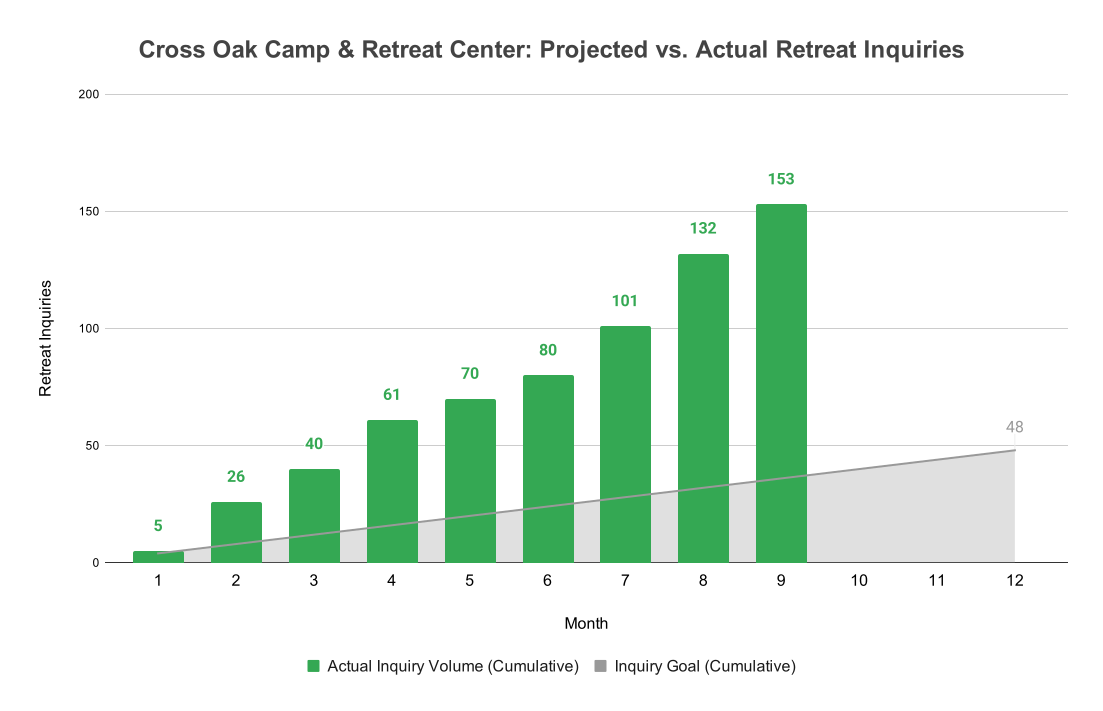
He chose the version built around a new website and paid search, since the denomination already had access to Google’s nonprofit ad grant. That plan projected 48 retreat inquiries and $280,000 in new bookings in the first year.
The number that mattered most, though, wasn’t in the projection. It was that John had something he could carry into a room and defend. He taped it to his desk beside a mentor camp’s revenue projection, and the conversation with leadership shifted from whether to try marketing to whether this matched where they were trying to go.
Putting It to Work
The website was rebuilt to work as a lead generation hub rather than a brochure, with dedicated pages for the group types people actually search for and search optimization built into the foundation instead of added later.
The inquiry form turned out to matter as much as the traffic. The old one collected a name, an email, and an open comment box, which meant every inquiry started with a round of questions before John knew what the group even needed. The new one asks for group type, attendance, dates, and lodging needs up front, and everything flows into the CRM with call tracking attached. John stopped spending his first two emails gathering basics and started answering the question the group actually had.
Paid search launched on the ad grant, reaching people already looking for a Christian retreat venue within driving distance. Formal SEO came later, once early results made the case for expanding the investment.
The Results
In the nine months since launch, Cross Oak has received 153 retreat inquiries through the website, against a first-year goal of 48. Another 78 tracked phone calls and 55 general contact submissions sit behind that number, so the real volume of interest runs higher.
John’s revenue forecast tells the rest. He is projecting close to $800,000 for the fiscal year, up almost $280,000, better than 50% growth in a single year and within a few thousand dollars of what the plan projected. It is also the first full fiscal year with the new system running, and the number is built on business already contracted, with most of the year still ahead of it.
The inquiries are also the right ones, which is the part most directors doubt. John’s close rate is 88%. As he puts it: “The moment I get them to see the grounds, it’s like it’s in the bag.”
Strangers are finding them now
Organic search has become the camp’s largest source of traffic. More telling than the total is the direction: search impressions have more than tripled since launch, and the site has climbed roughly eight positions in the rankings.
What changed is who’s arriving. Cross Oak now shows up on the first page for searches like “church camps in ohio” and “church camps near me.” Two groups, one from Chicago and one from Pittsburgh, told John that is exactly how they found him. Neither had heard the name before.
Some of the new interest also came from groups whose previous camp changed course, which happens more often now than anyone in this industry would like. What matters is that when those groups went looking, Cross Oak was findable and ready. A year earlier it would not have been.
That website was built with search in mind, and formal SEO work only recently began, so most of the compounding is still ahead.
A share of it now comes from AI
A small but growing number of inquiries arrive through AI assistants. The volume is still modest, but those visitors convert at more than six times the rate of any other channel. One of them was a group of about 250 people. When John asked how they found the camp, the answer was ChatGPT.
The constraint moved
The clearest sign the system is working is what John spends his time on now. He has turned away roughly $420,000 in business for a single reason: not enough beds.
So Cross Oak is doing what Andy did at the start, which is invest. A new dorm breaks ground this fall with two meeting rooms built into it, a twelve to eighteen month project that will let the camp host larger groups and run several at once.
The growth has brought real work with it. Six groups on the property in one week. A team that gets tired. An open chef position that is hard to fill because the right person has to want the ministry as much as the job. John has added staff in the office, tightened the systems that coordinate overlapping groups, and started looking hard at pricing that reflects what the facility is worth. Those are better problems than an empty calendar, and he is treating them like the next thing to solve.
“Has completely changed the way my camp has gained business. We are pulling in more leads now more than ever. Jen and her team have played a HUGE part in our new success!”
John Schwieterman, Cross Oak Camp & Retreat Center
Hear the full story from John on the Grow Your Camp Podcast:
What Changed
The inquiry count is the easy thing to point at. It is not the real change.
Cross Oak runs on a documented plan now instead of instinct, with performance measured against projections every month. That means conversations with leadership happen in numbers. Marketing stopped being the line item that gets cut first and became the thing that pays for the next building. John quotes his superintendent on this: so often marketing is the first thing to go when cuts come, and that is the biggest mistake an organization can make.
The camp John walked into was deciding whether to exist. The camp he runs now is deciding how big to become.
Final Word
Plenty of organizations skip the strategy step. It feels slower than launching ads and less satisfying than a new website.
An audit tells you what is broken. A proposal tells you what a vendor sells. A Growth Action Plan tells you what the opportunity in your market is worth, what reaching it will cost, and what return is reasonable to expect, in enough detail that you can hand it to a board and defend it.
For Cross Oak, doing that first is what made everything after it work. The research said the demand was real. The plan said what it would take. John and his team did the rest.
If you are weighing whether your market justifies the investment, the first step isn’t a proposal. It’s a plan.
Schedule a discovery call to find out what the opportunity in your area looks like.